Understanding Current Market Trends
Goldman Sachs has made an intriguing observation: the patterns emerging in today's mega-cap tech sector bear a striking resemblance to those seen during the dot-com boom. This isn't merely idle speculation; it points to a significant market sentiment, one that could influence investment strategies moving forward.The Tech Dominance Dilemma
What’s fascinating here is the continued dominance of tech giants like Apple, Amazon, and Microsoft amid broader economic challenges. If you're actively investing or trading in this space, this dominance signifies a potential bubble. Historical parallels to the late 1990s should raise alarms—though these companies are profoundly entrenched in our economy, their overvaluation may mirror the unsustainable highs of the dot-com era. That said, the past is not a perfect predictor of the future. Factors like established revenue streams and diversified business models distinguish today's tech titans from those of yesteryear—even if market behaviors show warning signs. While the data doesn’t entirely explain why investor enthusiasm remains unshaken, it certainly invites scrutiny. In conclusion, the present landscape bears watching, particularly for those navigating investments in mega-cap tech. The echoes of past trends aren't just a curiosity; they hold lessons that are vital to informed decision-making today. Understanding these dynamics could shape your investment approach in what remains an unpredictable market.Market Dynamics Reminiscent of the Dot-Com Era
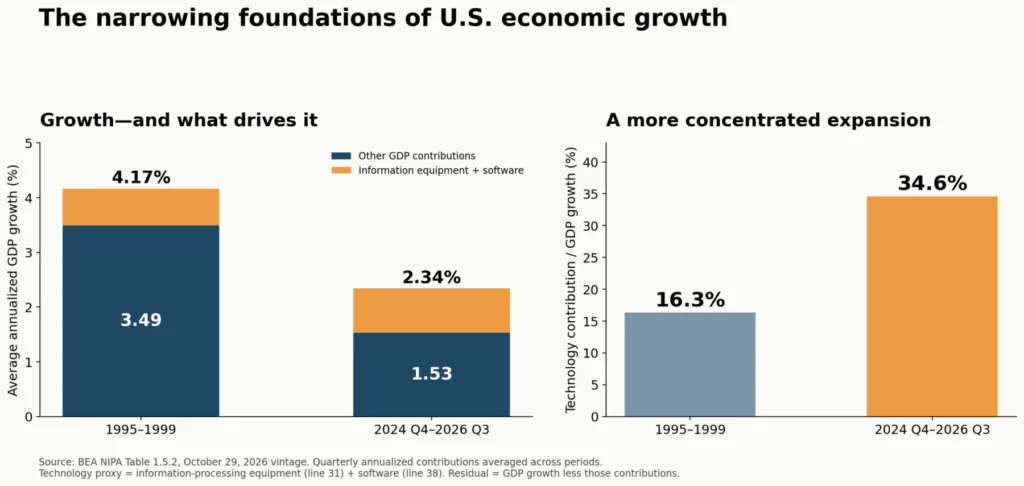
Analysts at Goldman Sachs are drawing parallels between today's market dynamics and the tumultuous dot-com bubble of the late 1990s. The firm highlights a growing dominance of mega-cap tech companies, suggesting that this trend mirrors the rapid rise and subsequent fall of internet stocks back then. What’s striking is how a handful of notable firms have become ubiquitous in the market, resembling the major players that once fueled the tech boom. Specifically, the report indicates that companies like Apple, Microsoft, and Tesla are not just leading their sectors but are also pulling the broader market along with them. This concentration ignites concerns about overvaluation, as many are questioning whether these stocks can maintain their meteoric ascent. Remember, during the peak of the dot-com era, excessive enthusiasm propelled valuations to unsustainable highs—a pattern we might be seeing again. The current scenario presents a mixed bag: while consumer confidence and spending appear healthy, binary outcomes loom large. If these tech giants falter or market sentiment shifts, the repercussions could be significant, invoking fears reminiscent of 2000. With such a significant weight on these select companies, a downturn could trigger a rapid market correction.Investor Sentiment and Valuation Risks
Yet, here's the thing: it's not entirely clear whether investors are adequately factoring in the inherent risks. Many are still caught in the allure of tech’s potential, often overlooking the fundamental questions about sustainability and true growth rates. Have investors fully priced in potential regulatory headwinds or competitive pressures? It's a question that demands attention as the market continues to showcase flashy gains. Additionally, a reliance on these tech stocks for market performance raises alarms. If large funds pivot away due to rising interest rates or tightening monetary policy, it could create volatility that sends ripples beyond the tech sector. The data suggests that while the market is currently buoyed by these mega-cap stocks, a significant market correction could result as sentiment shifts. If you're navigating this space—whether as an investor or analyst—it's crucial to remain vigilant. Keeping an eye on market fundamentals amidst rising prices can provide clarity and possibly safeguard against the looming uncertainties. The echoes of the past may serve as a warning: a market heavily reliant on a few names is a market poised for turbulence.The Market's Uneasy Balance: An Ominous Echo of the Tech Bubble
Goldman Sachs’ recent observations are raising eyebrows and drawing comparisons to one of the most notorious periods in market history—the late-1990s technology bubble. At the heart of this concern is an alarming trend: nearly half of the S&P 500 companies now exhibit negative beta behavior. This means these stocks are showing an unusual tendency to decline when the broader market rises, indicating a disconnect that could signal underlying vulnerability in the market structure. While it's essential to recognize these numbers within a wider context, they reflect a shift that is anything but trivial. Negative beta rates have typically been rare among large-cap stocks, suggesting that the recent proliferation signals something deeper than mere statistical anomaly. Goldman asserts this is more about the increasing concentration of the S&P 500, where a select few mega-cap tech and AI-driven stocks dominate the index's overall performance. These high-flying tech names have essentially become the market's mainspring, propelling the index to new heights while much of the corporate landscape grapples with lagging performance. This discrepancy paints a misleading picture: a robust index level that doesn't capture the often bleak realities faced by a significant segment of companies in more traditional sectors like industrials, consumer goods, and energy.This market dynamic might lead to inflated optimism among passive index fund investors, who see gains but fail to recognize the potential pitfalls lurking beneath the surface. As these funds continue to buy more of the winners, this loop reinforces a dependence on a narrow segment of the market, skewing risk perceptions.
But what happens when the momentum of these leading stocks falters? History has shown us that extreme divergence can reverse rapidly, and smart portfolio management becomes increasingly complex. For instance, portfolio managers who aim to sidestep the mega-caps may inadvertently position themselves defensively—not out of strategy but simply due to the changing benchmarks. One of the critical issues here is the evolving definition of market risk. If the index's performance increasingly hinges on just a handful of companies, a beta value of 0.6 for a stock might not accurately reflect its volatility. Instead, it could indicate a lack of exposure to the dominant market trends that are propelling the index upward. Economic conditions further complicate this situation. Rising bond yields, a stronger dollar, and tight financing environments put additional pressure on companies not tethered to the technology sector’s growth narrative. While it’s too early to conclude that we are on the brink of another tech bubble burst, vigilance is required. The current market structure is less about fundamental performance and more about a few companies carrying an entire index. As things stand, it’s possible for the market to reach new highs while vast parts of corporate America struggle to keep pace. This unsettling reality is the crux of Goldman’s warning—and it’s one every investor needs to understand as they navigate this complex market terrain. There’s plenty of room for cautious optimism, but expectations should be tempered with a healthy dose of skepticism. The echoes of history can provide valuable lessons, and ignoring them could lead to harsh lessons down the line.