How I invest in 2026
The largest driver of my net worth isn’t a fund or a stock. It’s the businesses I founded. That’s a useful starting point for this look at my portfolio, because my choices reflect my circumstances and risk tolerance; they aren’t a template for yours.
This is an update to an article first published in 2020, the third installment in a four part series written during the pandemic. The series began with “The Get Rich Portfolio” and “The Stay Rich Portfolio”, followed by “How I Invest My Money” and “Investing in the Time of Corona”. The first two pieces lay out approaches to building and preserving wealth. I hold some nonconsensus views on both, so you may want to read them first. There’s also a running list of my nonconsensus market views.
Here, I’m showing how those ideas come together in my own finances. Readers have asked about my personal investing for years, often around the turn of the year. Some want a practical example; others are curious about how someone in the investment business allocates money. And some just want to watch from the sidelines and cheer or throw virtual tomatoes on Twitter.
Either way, the useful question is what approach works for you. John Bogle favored low cost index investing and put the case plainly:
“To repeat, while such an index-driven strategy may not be the best investment strategy ever devised, the number of investment strategies that are worse is infinite.” – John Bogle
My strategy isn’t the best one for everyone. I think it works for me, at least for now. That distinction matters: my family, finances and tolerance for risk aren’t yours, and there are many reasonable ways to invest. The hard part is avoiding the approaches that are plainly poor fits.
A few limits on what follows. This account is mainly of interest to my family—though, honestly, they probably won’t read it. I’m sharing the thought process because it may give other investors a useful comparison or prompt a debate, not because I’m recommending anyone copy my portfolio.
The figures are approximate. Precision to the decimal point would create a false sense of accuracy, and the point here is to show how the major pieces fit together. Nor should you expect stock tips: I’ll describe my public investments, but their allocation changes little from year to year because the funds do much of the work. I’m somewhere between wealth building and wealth preservation: I have a young family and financial needs ahead, but I also want to protect our future and sleep well. My approach will change as my situation does.
Businesses, property and private investments
Cambria, my asset management company, and The Idea Farm, my research company, account for an estimated 75% to 99% of my net worth. The precise share is debatable, but the main point isn’t: owning these businesses is my biggest wealth building bet. That’s also true for many business owners. Elon Musk once put the risk bluntly: “If Tesla & SpaceX go bankrupt, so will I. As it should be.” His comment captures the concentration that can come with ownership stakes.
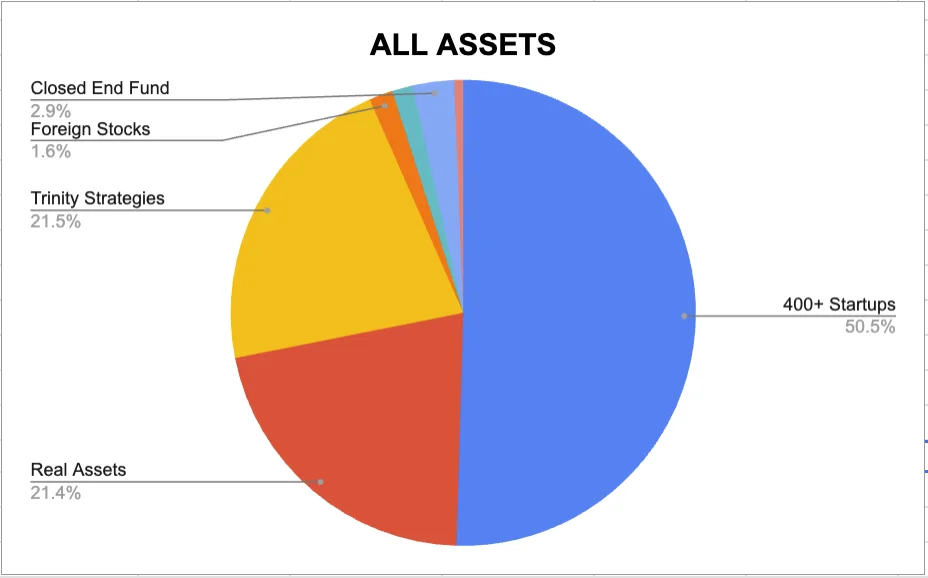
Set those companies aside, and my holdings are roughly 50% in more than 400 private startup investments, 20% in real assets such as housing and farmland, with the balance in public investments. Over time, I’d prefer those three categories to sit closer to one third each. Appreciation and other developments have pushed them out of balance.
That target resembles the roughly 2,000 year old Talmud portfolio, which divides wealth among real assets, businesses and safe reserves.
Our free Global Asset Allocation PDF covers several allocation approaches, including the Talmud portfolio. A second edition is planned for 2027.
Farmland has generally been a stable, income producing asset, with returns that can be relatively uncorrelated with the rest of a portfolio. It also has personal meaning for me because of my family’s roots in the Midwest. Land is a good place to get away, and its value doesn’t flash across a screen every minute when public markets are in turmoil. Here I am trying to work out whether farmland has gone up or down since a few years ago:

If you ever want to meet at The B-Hive in Kansas, let me know.
The main change is that I’ve sold my direct farmland holdings and moved into farms offered through private platforms that have appeared on my podcast over the years. I still value the connection to the region, but farming takes work, and much of my family there is aging out of the business. With fewer younger relatives interested in farming, land ownership becomes more of a financial decision than a sentimental one. I’d rather have someone else manage the work and spread investments across regions and crops. I expect to add farmland over the next few years; for now, I can visit my brother when I need fresh air.
I’m undecided about counting my home as part of the portfolio, but I lean toward including it.
My angel investments are another part of the wealth building side. I’ve written about them in “Journey to 100x” and discussed them on the podcast. Depending on how they turn out, they could belong in a “Get Poor” bucket instead. The appeal includes long, potentially indefinite holding periods and potential tax benefits from qualified small business stock. I also find the work engaging and, frankly, more optimistic than the daily stream of negative geopolitical news about public markets.
I’ve treated the investments as tuition. The benchmark I care about is the U.S. stock market, and I hope the portfolio does better, but that’s far from assured. Most of the more than 400 deals I’ve joined are still young. About 100 have exited: 53 went bankrupt or to zero, 27 were acquired, seven went public and 11 provided secondary liquidity.
Some still open investments have raised follow on rounds, and a few are unicorns on paper. Those interim marks make the record look better than a complete cycle may justify. Private angel investing has had a very favorable run during this period; we’ll need another decade to see how the portfolio fares through a full cycle. I lived in San Francisco during the early 2000s collapse, so I expect both winners and losers.
The largest realized wins so far returned 23 times and 57 times the original investment. I’m still waiting for the 100x outcome. That kind of skew is central to the power law in private markets, and it also appears in public markets. For further reading, see research from Bessembinder, JP Morgan, Vanguard and Longboard. The Chris Mayer podcast also discusses public market 100 baggers.
Private investments force a different kind of patience: you often can’t sell. Had those dollars been in public stocks, I’d probably have sold after a double or triple. “Buy and hold” sounds easy until a position has doubled and you’re deciding what to do with it. I plan to keep investing in startups as opportunities arise. Because I’ve invested across vintages since 2014, the portfolio now spans companies from startups with market capitalizations around $2 million to established, cash flowing decacorns valued above $10 billion.
Sign up for email updates on this topic.
My public portfolio
Fund managers often make a forceful case for why clients should invest with them. Ask how much they invest in their own funds, though, and some have nothing invested alongside their clients. The chart below shows the share of managers with no personal investment in the funds they run, based on information from Russ Kinnel at Morningstar FundInvestor.
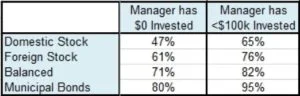
That’s hard to defend. The mutual fund business has a long record of high fees, tax inefficiency, sales loads, 12b-1 fees and other practices that work against investors. Maybe some managers have good reasons not to own their own funds. Still, skin in the game matters. If I wouldn’t invest my own money in a Cambria fund, why should anyone else? A California municipal bond manager may not want all their wealth in that one fund, but the basic question remains: would they invest in it at all? Some managers might struggle to answer honestly. Plenty of fund products seem to lack a clear sense of purpose.
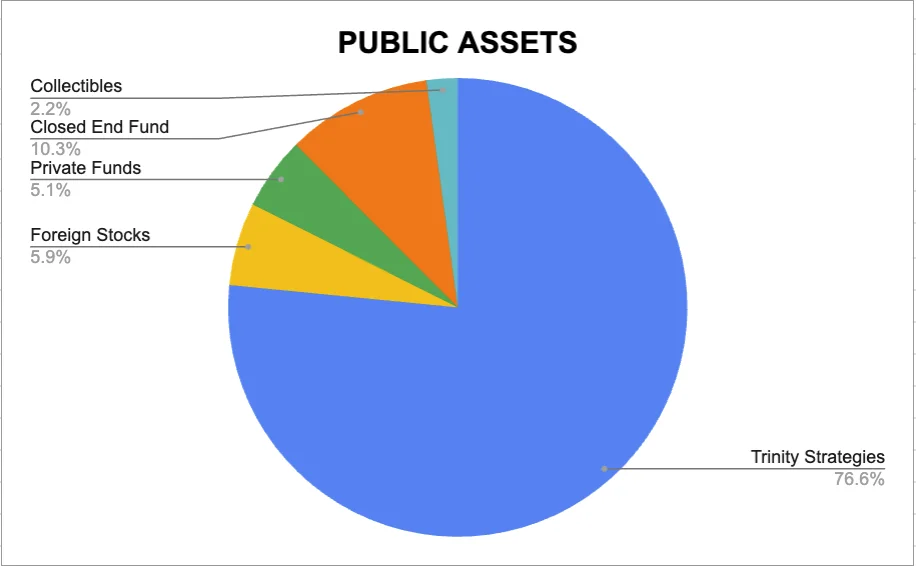
I put nearly all the public assets I can into funds I manage, then leave them on autopilot. For me, that’s part of the wealth preservation bucket. My preference is a moderate risk portfolio that aims to beat plain buy and hold while reducing volatility and drawdowns—a demanding goal, and certainly not a guaranteed outcome.
I call the approach “buy and trend,” or the Trinity strategy. I use the publicly traded Cambria Trinity ETF (TRTY) and Trinity strategies on Betterment.
Roughly half of Trinity is a global strategic allocation to stocks, bonds and real assets. It tilts toward value and momentum instead of relying on standard market capitalization weights. My concern with buy and hold on its own is that it can move in step with my human capital and the economic cycle: when the economy weakens, the portfolio may weaken too.
The other half uses trend following strategies. The aim is to lower volatility and drawdowns while targeting returns similar to buy and hold, with lower correlation between the two halves. Ideally, trend performs well when buy and hold struggles, and vice versa. Trend strategies can help in weak markets, but sticking with them when other assets are rising can be difficult. No approach works in every market.
This mix suits me because I’m both a trend follower and a value investor. Trend gives me the option to move half the portfolio into cash or hedges if markets begin trending down. Many of those strategies are currently exposed to real assets such as commodities and real estate, which could help if inflation remains elevated. The value side keeps me invested in assets that look inexpensive over long periods, including foreign stock markets as I see them today.