
Time is the resource behind nearly every financial decision, though it rarely appears on a balance sheet. We trade hours for income, exchange that income for goods and services, and make plans on the assumption that there will be time to carry them out. A recent birthday, a household cleanout and the loss of a dog have made that chain feel less abstract to me.
We talk about time as if we can manage it directly: savor the moment, be present, have a good day. Some days cooperate; others don’t. The language reflects our wish to control time, even when what happens within a day is partly beyond our reach.
Age changes the urgency
Round birthdays never seemed to provoke a crisis for me. Turning 60 did produce a clear thought: the fourth quarter had started, my team was seven points behind, and there was still work to do. That image shifted my attention toward projects I’d postponed.
I wrote a book, took on personal projects, handled financial and estate planning, and stopped putting off some major purchases, travel and activities. For years, I’d treated those plans as things I could get to eventually. The realization that I wasn’t immortal made “eventually” feel like a poor plan.
This wasn’t a bucket list so much as a short inventory of things I still wanted to do. The distinction matters. A list can make the future seem neatly scheduled, while real life remains uncertain. But recognizing that time is limited can still help us decide which plans deserve attention now.
What the old laptops made visible
A leak in the exterior of our house sent water into the basement, so we cleared space for contractors. Among the accumulated belongings were six MacBooks, dating back to the 2000s. Each had once been expensive, useful and important. Now they were old machines taking up room.
I remembered the excitement of buying them: each one faster or better than the last. That excitement had obscured a simple fact. Products wear out, become damaged, lose usefulness and eventually get replaced or discarded. We were warned not to throw away old laptops without removing their hard drives, a reminder that the contents can outlast the device itself.
There’s a small lesson here about how we think about purchases. The value of a thing isn’t permanent just because it felt valuable when we bought it. Money goes toward items and experiences with different useful lives, and those lives end. The second law of thermodynamics, as I put it to myself while looking at the machines, doesn’t make exceptions for consumer electronics.
Time as a measure and an experience
My interest in time goes beyond calendars and birthdays. I’m not convinced that the felt passage of time exists independently of human consciousness in the way a clock face suggests. Physics uses time as a way to describe relationships among events and motion. In that sense, it’s an essential measure, but the measure is tied to what changes.
A second, for example, is defined by the duration of 9,192,631,770 periods of radiation associated with a transition in a cesium-133 atom. Clock hands and atomic transitions give us ways to measure time consistently. They don’t necessarily settle what time is outside those measurements.
Relativity treats spacetime as a four-dimensional structure, with three dimensions of space and one of time. Other approaches to gravity raise different questions: the Wheeler-DeWitt equation, for example, has no time variable in its usual formulation. I don’t find that enough to resolve whether time is an independent feature of reality or a framework we use to make sense of it.
Our sense of a moving present may be even harder to pin down. We experience a “now” at a particular place, then another “now” a moment later. My suspicion is that this flow is shaped by the mind as it organizes experience. Whatever time’s status in physics, our personal experience of it changes dramatically as we age.
Money is time in another form
I contributed a chapter called “Money Is Time” to How I Invest My Money Volume Two, published this week. I wanted to write about an idea that could apply across people’s different financial circumstances: money is closely connected to the time we spend earning and using it.
First, money measures economic contributions made through time. Effort, expertise, skill and judgment all take time to develop and apply. Second, everyone receives the same 24 hours in a day. When we’re young, it can feel as if hours and years are abundant. With age, time becomes harder to treat as an unlimited resource.
The third point follows from the first two: spending money also commits time. A purchase represents some portion of the hours, effort and experience that produced the money used to pay for it. That doesn’t make every expense a mistake; it makes the trade-off worth seeing clearly. The days can feel long, while the decades pass quickly. That gap deserves a place in how we decide what to buy and what to put off.
Money Is Time
Time travel has a location problem
Science fiction often treats time travel as if a traveler could return to a past moment and simply arrive at the same spot. But Earth is moving. It orbits the Sun at about 66,600 miles per hour, the Sun moves around the Milky Way at about 515,000 miles per hour, and Earth’s rotation adds motion of roughly 1,040 miles per hour. A traveler would need to account for those movements, as well as the universe’s expansion.
The source estimates our combined motion at 828,000 miles per hour. Over a century, that amounts to about 725 billion miles of travel. Even a very small error in the arrival location could put someone inside Earth, thousands of feet above the ground or out in space. It’s a useful reminder that a story’s simple premise can hide a difficult accounting problem: where, exactly, is the destination?
There’s also the question of the future. I don’t buy the idea that past, present and future all exist at once as a fixed block. That picture seems to leave causality unexplained. In my version, someone could travel to the past only to return to the moment they left. The future would remain unwritten because events between now and then still have to happen.
Loss makes time personal
I’ve often divided my life into its dogs. Erev was the Labrador retriever I had as a child. Killer was a stray I adopted in college, and my father grew attached to him. After we moved out of the city, Max, a shepherd-bearded mutt, joined us. Jackson, a Labradoodle, kept Max young until Max was 17. Lexi died young of encephalitis; Kodie, now five, followed her. Teddy, a Portuguese Water Dog, came after Max.
We had to say goodbye to Teddy last week. I knew it was coming, but that knowledge didn’t soften the shock of losing him. The passage of time can be discussed as a question in physics or a constraint in financial planning. Grief makes it immediate.
Dogs experience our absence differently from the way we mark it on a clock. One account suggests they can detect the gradual decline of a person’s scent after that person leaves, and learn to associate that change with a return. People’s lives are full of complicated relationships, but the bond with a dog can feel direct: affection without the same layers of history, argument and expectation. When a dog is gone, that simplicity leaves a particular kind of absence.

Age narrows the range of possibilities
With age, it becomes easier to see the broad outline of the life you’ve built: what you’ve accomplished, what you’ve earned, whom you’ve influenced and who has influenced you. It’s not a complete accounting, but it can bring a clearer sense of who you are.
That clarity comes with a cost. Some ambitions depend on a long runway. Learning a language, starting a business or learning to read music may feel harder when the project could take five, ten or twenty years. The question isn’t whether such plans are impossible; it’s that fewer years remain to absorb delays, changes in direction and the ordinary surprises of life.
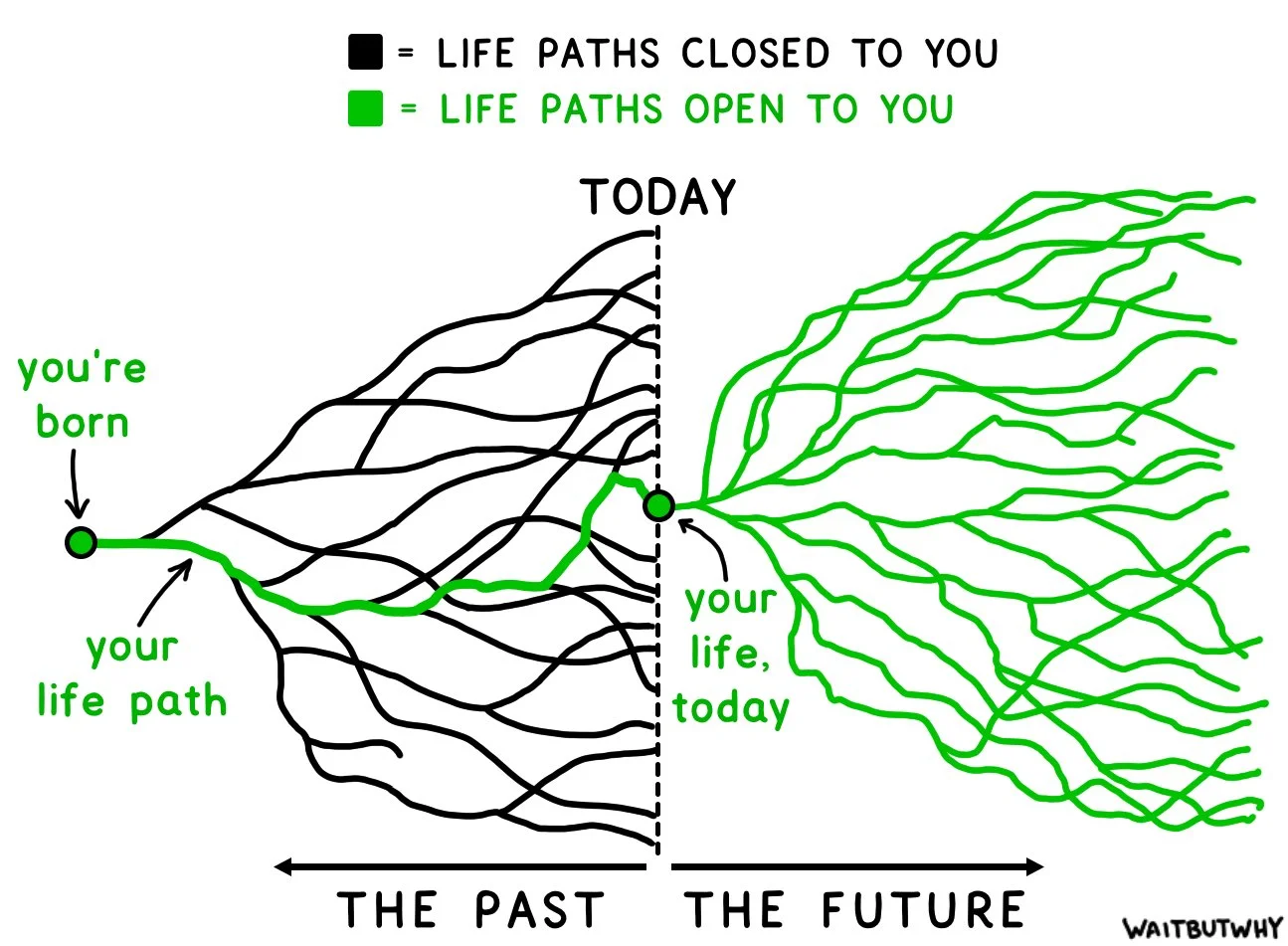
That’s the trade-off I see most clearly in aging: greater agency can come with fewer open possibilities. Time gives us experience and a better sense of what matters, while also limiting how many long projects we can pursue. My practical takeaway is simple: treat time as part of the price of a decision, and give the plans that matter a place on the calendar while they’re still possible.